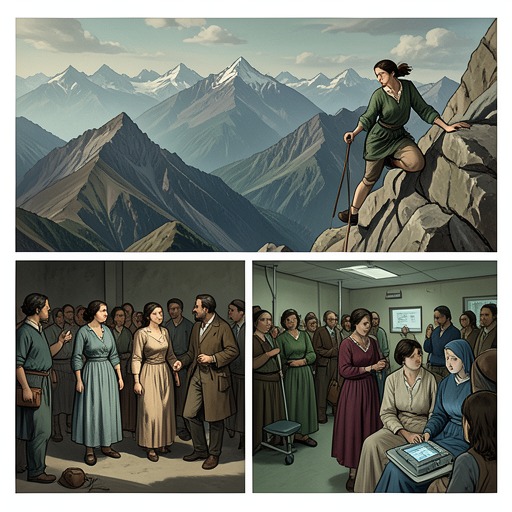
Himalayan range
The Satanic VersesThe Himalayan range enters the novel through Alleluia Cone’s encounters with Everest, but it extends beyond a climbing destination: it becomes a landscape that unsettles ordinary distinctions between the real and the visionary, the earthly and the exalted. Its peaks inspire an enduring attachment in Alleluia, even as their sacred and dangerous character makes that attachment threatening.
Mountain, apparition, and memory
Descending from Everest, Alleluia sees west of Camp Six, across the Rock Band and below Cho Oyu, what first appears to be Shangri-La. The vision is instead a vast city of sharp ice needles; when Sherpa Pemba warns her to concentrate and she looks back, the city has vanished. The apparition returns her in memory to the Bayswater study where her father, Otto Cone, had warned her against imagining the world as a harmonious whole. His conviction that incompatible realities coexist gives the vision a context: the impossible city need not be reconciled with the familiar landscape in order to matter.
The mountains recur beyond the climb itself. In London, Alleluia tells Gibreel Farishta that she has seen visions elsewhere too: on an early-morning walk beside the Embankment, ten icebergs shaped like the world’s ten highest mountains appear in single file on the river, with Everest bringing up the rear. As the mist clears, the icebergs disappear. The episode extends the Himalayan landscape into the city and into Alleluia’s experience, without settling whether the visions belong to the external world or to her own perception.
The range carried into everyday life
Long before she reaches Everest, Alleluia feels the mountain’s presence in her imagination. Her apartment is crowded with representations of the peak in materials ranging from cork and plastic to tile, stone, acrylic, and brick. One miniature Everest is sculpted from ice and kept in her freezer; another, made of weathered pine, is a gift from the Sherpas of Namche Bazar.
Pemba has carved the wooden model in detail: it includes the icefall and the Hillary Step, and the route taken to the summit is scored into the wood. On its underside is a painstaking message from the Sherpas advising Alleluia not to attempt the climb again. The model thus holds both the attraction of the ascent and its warning: the route is made tangible, but so is the instruction to stop.
Exaltation and danger
The novel links the mountain’s form to transformation. An iceberg is water striving to become land; a mountain, especially a Himalayan peak such as Everest, is land reaching toward the sky. The image makes the mountain a kind of grounded flight, almost transformed into air. Its elevation is not simply scenic grandeur: it gives physical shape to Alleluia’s sense of the exalted.
That elevation is also perilous. Alleluia privately fears that, having seen the mountain’s divine face once, she would die if she returned. The fear does not extinguish her longing; the prohibition intensifies it. She experiences Everest as at once transcendent and diabolic, qualities the novel presents as inseparable rather than opposed. Although her flat feet make serious mountaineering impracticable, she remains drawn to the range and secretly entertains the impossible prospect of a solo ascent, recalling Maurice Wilson’s unachieved attempt. The Himalayan range therefore persists as both a visionary presence and a dangerous desire that no ordinary boundary can quite contain.